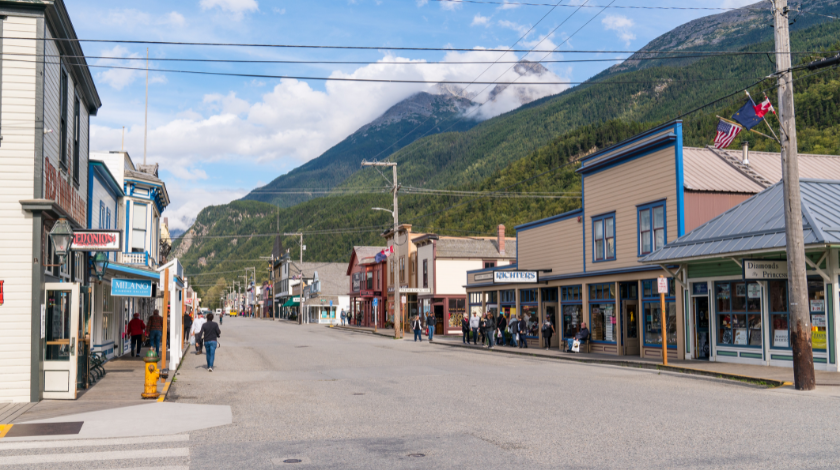
Skagway’s wooden sidewalks creak under your feet in a rhythm that feels like a heartbeat. It’s a slow, steady sound, completely at odds with the chaotic boom this place once knew. I remember standing on Broadway Street for the first time, sandwiched between a massive cruise ship looming in the fjord and a perfectly preserved false-front building from 1898. It was a surreal feeling, like being in two centuries at once. Everyone talks about Skagway’s history, but until you’re there, feeling those planks beneath your boots and smelling the damp, mineral scent of the mountain air, it’s just a story. Let me tell you, the story is very much alive here.
This town, with a permanent population you could fit into a few large houses, becomes a bustling hub each summer. But to see it only as an Alaska cruise port is to miss its deeper, wilder soul. Skagway’s real identity is etched into the cliff faces of the White Pass and woven into the quiet, persistent growth of spruce trees over forgotten trails. I want to share with you not just what to see, but how to feel the layers of this place, from its lawless Gold Rush roots to its present-day role as a gateway to profound natural beauty.
The Echo of Dreams: Skagway’s Gold Rush Frenzy
To understand Skagway today, you have to close your eyes and imagine the pandemonium of 1897-98. When gold was discovered in Canada’s Klondike, tens of thousands of hopeful stampeders descended on this tiny, muddy cove. Overnight, Skagway became a classic boomtown, but one of the most infamous. It wasn’t a place of guaranteed riches; it was a brutal filtering station.
These men and women arrived with ornate Parisian crystal cabinets and steam-powered pianos, utterly unprepared for the Chilkoot or White Pass trails ahead. The rule was simple: to enter Canada, you had to bring a ton of supplies. That meant making dozens of trips up soul-crushing, icy slopes, moving your gear piece by piece. The stories hit hardest when you visit the Klondike Gold Rush National Historical Park museum on Broadway. It’s free, and it’s the essential first stop. Don’t rush through. Look at the faces in the photographs—the hope, the exhaustion, the desperation. It frames everything else you’ll see.
And then there was the lawlessness. Skagway’s most famous villain was Jefferson “Soapy” Smith, a charming con artist who ran the town with a gang of thieves. His schemes were ingenious and cruel, robbing stampeders of their life’s savings before they even took a step toward the gold fields. His reign ended in a dramatic shootout on the Juneau Wharf with vigilante Frank Reid. Both men died. They’re buried in the Gold Rush Cemetery at the edge of town, a spot many tour buses fly past. It’s worth the short walk or shuttle ride. Soapy’s grave is often marked with pennies (a nod to his cons), while Reid’s is a grander monument. The quiet, mossy atmosphere there speaks volumes about how quickly frontier justice was meted out.
A Journey on Iron Tracks: The White Pass & Yukon Route
If you only do one paid excursion in Skagway, let it be this. The White Pass & Yukon Route railway isn’t just a train ride; it’s a moving history lesson and one of the most stunning scenic journeys in North America. I was lucky enough to get a seat by the window in an old-fashioned carriage. The train chugs slowly right from the downtown depot, which immediately makes you feel part of a living tradition.
As you climb, the town shrinks into a colorful Lego set below. The train clings to the side of mountains, with the gorge dropping away precipitously just inches from the tracks. You’ll cross trestles that look impossibly delicate and enter pitch-black tunnels blasted through granite. The conductor narrates the trip, pointing out the old toll trail where you can still see the gouges from wagon wheels and, hauntingly, the “Dead Horse Gulch.” The name says it all. Over 3,000 pack animals died on that stretch of the trail, a grim testament to the rush’s brutal cost.
The railway itself, built in 1898 during the rush, is an engineering miracle. To think it was constructed by hand in such hostile, remote conditions boggles the mind. You reach the summit of the White Pass, and the landscape opens into a vast, rocky, almost lunar expanse. On my trip, a low mist clung to the peaks, and for a moment, I could almost see the endless line of stampeders, heads down, trudging into the unknown. The train offers various trips, but the summit excursion is the classic. It gives you the full, powerful scope of what those gold seekers were up against. It’s humbling.
Strolling a Living Museum: Broadway Street and Beyond
After the train, wandering Broadway Street feels different. You appreciate the preservation. The entire downtown is part of the National Historical Park, so the false-front buildings aren’t replicas—they’re the real deal. The most photogenic is the Arctic Brotherhood Hall, entirely covered in over 20,000 pieces of driftwood. It’s surreal and beautiful.
Pop into the Red Onion Saloon. It was a bordello during the gold rush, and the downstairs bar maintains that raucous spirit. Upstairs, you can take a tour with a “madam” guide for a fun, slightly cheeky look at that side of history. For a quieter experience, I love the Mascot Saloon museum. It’s set up exactly like a 1898 bar, complete with bullet holes in the painting behind the counter. It’s silent now, but you can easily imagine it thick with smoke and loud with tall tales.
My advice? Get off Broadway. Walk a block over to State Street or Main Street. The houses here are where ordinary people lived—shopkeepers, railway workers, families who stayed after the rush faded. You’ll find beautiful, weathered homes with lush wildflower gardens. It reminds you that Skagway wasn’t just a temporary carnival; it became a community that weathered the long, quiet winters after the gold rush circus left town.
The Trail Less Traveled: Skagway’s Natural Sanctuary
Here’s a secret many day-trippers miss: Skagway is a fantastic place for an easy, breathtaking hike. The cruise ship crowds tend to cluster in a ten-block radius, but solitude is just a short walk away. My favorite escape is the trail to Lower Dewey Lake. The trailhead is literally a five-minute walk from the cruise ship docks. In less than thirty minutes of moderate uphill climbing through a dense, green forest, you emerge at the serene, tree-lined lake. The silence is profound, broken only by the call of a raven or the splash of a jumping fish. I sat on a rock there once for a full hour, and only two other people passed by. It was the perfect antidote to the bustling port below.
For the more ambitious, the Chilkoot Trail begins nearby in Dyea, the ghost town rival to Skagway. While hiking the full 33-mile trail to Canada requires serious planning, you can day-hike the first few miles to get a tangible sense of the stampeders’ first steps. The trail is wide and worn deep—a physical scar on the land from the thousands of boots that passed over it. Walking it, even for a short way, is a deeply resonant experience. You’re literally walking in their footsteps, surrounded by rusting artifacts and the slow, patient reclamation of the forest.
When to Visit and How to Make it Yours
Skagway’s personality changes with the seasons. Summer (June-August) is vibrant, with up to four massive ships in port a day. Everything is open, the flowers are spectacular, and the energy is high. But it can feel crowded. May and September are the shoulder seasons. Fewer ships mean a quieter town. Some shops may have shorter hours, but you get a more authentic, peaceful feel. The fall colors in September are stunning, painting the mountainsides in gold and fire red. I’ve been in both seasons, and while summer is convenient, there’s a special magic in the quiet of September, when you feel the town beginning to exhale and prepare for winter’s deep sleep.
If you’re coming from a cruise, you have choices. You can book an excursion through the ship for ease, or with a local operator (often for a better price). The train is a must-do for many, but excellent small-group van tours also go up the pass and into the Yukon, offering more flexibility to stop for photos with the famous “Welcome to Alaska” sign or at breathtaking lakes like Emerald Lake. Don’t be afraid to mix a structured tour with a few hours of solo exploration. Use the free National Park walking map, find that quiet trail, or just sit on a bench and watch the world go by.
Conclusion
Skagway’s legacy is a tapestry of extreme contrasts: greed and generosity, brutal hardship and incredible beauty, roaring crowds and profound silence. It’s a place where history isn’t locked in a glass case; it’s in the creak of the sidewalk, the steam of the train whistle, and the cool shade of a hiking trail that once saw so much desperate hope.
You can come for the postcard and the souvenir, and there’s nothing wrong with that. But if you listen closely, you’ll leave with something more valuable than gold—a connection to a powerful human story, set against some of the most dramatic scenery on earth. Skagway doesn’t just tell you its history; if you let it, it makes you feel it in your bones. And that is a treasure that lasts long after you’ve sailed away.
Frequently Asked Questions (FAQ)
Q: Is Skagway worth visiting if I’m not on a cruise?
A: Absolutely. While most arrive by ship, you can reach Skagway by the Alaska Marine Highway ferry, by car via the Alaska Highway, or even by flying into nearby Haines and taking a ferry. Visiting independently allows you to experience the town after the ships leave, which is a wonderfully peaceful and authentic time.
Q: How much time do I need in Skagway?
A: From a cruise ship, a full port day (6-10 hours) is enough to do one major excursion (like the train) and explore the historic downtown. To truly soak it in, including a longer hike or a trip to Dyea, consider an overnight stay.
Q: What is the best time of year to visit Skagway?
A: The main tourist season runs from early May to late September. July and August are the warmest and busiest. May and September offer fewer crowds and beautiful seasonal changes (spring blooms or fall colors), but slightly cooler and rainier weather.
Q: Can you see the Northern Lights in Skagway?
A: Yes, but primarily during the winter months (October to March) when there is enough darkness. The summer has nearly 24 hours of daylight, making aurora viewing impossible. Winter is a quiet, starkly beautiful, and very local time to visit.
Q: What should I pack for a day in Skagway?
A: Always, always pack layers. Even on a sunny summer day, weather can change rapidly. A waterproof jacket, comfortable walking shoes (not just sandals), a sweater, and sunglasses are essentials. The train can be cool, and the trails can be muddy.